
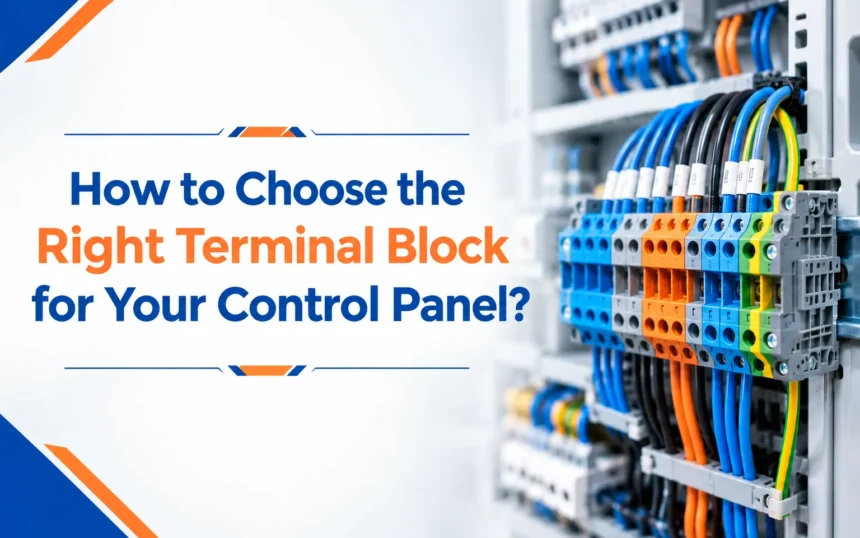
A control panel relies on wiring that’s safe, organized, and consistent. Selecting the appropriate terminal block creates a clear connection with safety between incoming and outgoing wires and makes installing, testing, troubleshooting, and maintaining the panel more efficient. But, beyond size and cost, there are many factors to consider when selecting an electrical terminal block.
The right choice depends on the present rating, wire size, connection method, mounting system, levels and panel space you have.
Learn how to decide on terminal block options for electrical and industrial control panels.
What Is a Terminal Block and Why It Matters in Control Panel Design
A terminal block is an insulated modular wiring device which secures two or more electrical wires. It provides a convenient, organized platform for wiring, creating a neat termination point rather than wiring the wires together.
Terminals can be used to help organize your wiring, make circuit identification easier, and assist with maintenance. There are several types of control panel terminal blocks available such as feed-through, ground, disconnect, fuse, distribution and multi-level.
BTC offers power distribution manufacturer brands such as Connectwell and Suraj terminal blocks for applications such as switchgear, OEM, automation, panels, and power distribution.
Types of Terminal Blocks: Screw, Spring, DIN Rail & Feed-Through Explained
The only differences between the terminal blocks are the connection method, function, and mounting arrangement.
- Screw Terminal blocks are a type of terminal block that use a screw-clamp to lock the conductor in place.
- Spring-loaded terminal blocks apply pressure using a spring. Connectwell has spring-loaded versions available when extra secure connection is desired.
- DIN rail terminal blocks can be mounted on DIN rails. These provide a means of orderly wiring in control panels. Some products support mounting on DIN 32, DIN 35, or DIN 35, DIN 15 rails.
- Feed-through terminal blocks are used to simply run a line directly across from one side of the terminal to the other and are typically used in control, automation, instrumentation, and power-distribution wiring.
Screw Terminal Block vs Spring Terminal Block: Which One Should You Choose?
The selection is application and installation specific.
- Screw clamp blocks use a tightening screw to lock the conductor in position and tighten the connection to the prescribed torque. Spring-loaded versions use a spring structure built into the block to achieve the clamping force.
If the panel wiring requires high bandwidth, frequent installation, tight mounting/installation space or vibration, the spring-loaded design can be taken into consideration. In the case of conventional panel wiring with screw termination already a design practice, screw terminal blocks may remain a viable option.
Always adhere to the relevant stripping length, the conductor ranges and the tightening requirements.
How to Choose the Right Current Rating for Your Terminal Block
Electrical terminal block current rating is one of the most important specifications.
First, determine the amount of direct current that the connected circuit will carry; Next, choose a rated current terminal block equal to or higher than the rated current needed for your application, and refer to the corresponding electrical safety standards and installation conditions.
For example, Connectwell’s CTS50/70N high-current terminal block, which is rated to 192 A as per IEC specifications and can accommodate stranded conductors of 10 mm to 70 mm.
High-power Conductor sizes for high-power use Special high current terminal blocks exist. For example, the CBB150 from Connectwell has an IEC-rated current of 309 A and a conductor size of 150 mm.
Pick a block for the load you plan to use. Do not base your choice on a “typical” load. Look for rated current, voltage, conductor size, temperature limits, and standards from the manufacturer.
Matching Terminal Block Size to Wire Gauge (AWG/mm²)
The terminal block should be rated for the actual conductor size used in the panel.
Verify the minimum and maximum conductor cross-section provided by the manufacturer. For instance, a Connectwell CTS4USC spring-loaded terminal block handles stranded conductors from 0.2 mm up to 4 mm (or 22 AWG to 10 AWG).
Crimping If you use a terminal block that is too small the conductor might not pass all the way through the entry hole or clamp. If you go too large it might produce a substandard connection. Select the terminal block that size with the actual wire/ferrule/lug configuration in mind.
Single-Level vs Multi-Level (Multi-Tier) Terminal Blocks: Choosing by Panel Space
Single level blocks offer a single level of connection. They are easy to position and identify. They are appropriate where there is enough DIN rail space.
Whereas in Multi-level or multi-tier terminal blocks multiple connection levels are accommodated in a small installation space. Multi-level terminal blocks can increase wiring density and may also reduce the space for the terminals on the rail.
Opt for multi-level layouts if the panel space is limited, but ensure that you consider access for testing, marking, and maintenance before implementing.
DIN Rail Mounting: What to Check Before You Buy
For DIN rail terminal blocks, verify:
● Compatible DIN rail type and dimensions
Terminal block width and mounting height● End clamps and end plates
● Partition plates where required
● Marker and identification accessories
● Jumper or shorting-link compatibility
● Clearance around adjacent components
Connectwell offers its products in various rail types and accessories. Take the example of CTS10 series it offers DIN rail options and accessories like end clamps and partition plates.
Common Mistakes to Avoid When Selecting Terminal Blocks for Industrial Panels
Avoid these common selection errors:
- ● Selecting the proper ampere rating without perusing the real load
- ● Ignoring conductor cross-section or AWG size
- ● Choosing the wrong length block that cannot be placed onto your DIN rail
- ● Missing end clamps, markers, jumpers or partition plates
- ● Using an unsuitable terminal for high-temperature applications
- ● Ignoring the manufacturer’s tightening torque
Choosing multi-story block thinking only about the external appearance without considering access for repair work
Not confirming that the necessary approvals and electrical standards have been met
A good choice should take into account the entire application instead of one specification.
Why Choose BTC for Terminal Blocks (Connectwell & Suraj Electronics)
BTC provides terminal block solutions from Connectwell and Suraj Electronics for panel builders, OEMs, contractors and industries. BTC says it is an authorized Connectwell dealer and offers feed through, ground, fuse, disconnect and multi-level terminal block configurations.
The product range also includes wires and cables, switchgear, cable ducts, panel accessories, relay modules, enclosures and other electrical products enabling the customer to take care of many panel needs from one source.
For control panel applications that utilize terminal blocks, selecting the right specification and accessories can produce a cleaner, safer, and more manageable and serviceable control panel.
Frequently Asked Questions
Q1. What is the fundamental usage of a terminal block?
The terminal block is a safe and organized connection point to connect and distribute electrical conductors within a panel or electrical assembly.
Q2. What terminal block should I buy?
Review the necessary current and voltage ratings, the size of the wiring, how it is connected, if there is a need for a DIN rail, how many levels are required, the available panel space, and any accessories.
Q3. What are DIN rail terminal blocks?
DIN Rail Terminal Blocks are modular blocks that are used to attach to DIN rails that are installed inside of electrical control panels.
Q4. In what situations are high current terminal blocks used?
Use high-current terminal blocks for circuits that have current levels which exceed the ratings of standard control-circuit terminals. Confirm the maximum rated current for the unit and the maximum conductor range.
Q5. Can Connectwell terminal blocks be used in control panels?
Connectwell provides various terminal block options like feed through, disconnect, distribution, and multi-level terminal blocks for control, automation, instrumentation and power applications.
Q6. What is the difference between screw and spring terminal blocks?
A screw terminal has the wires held in the terminal with a screw clamp, while a spring loaded terminal has a spring clamp that uses a spring to provide the pressure. The correct termination depends on your application.