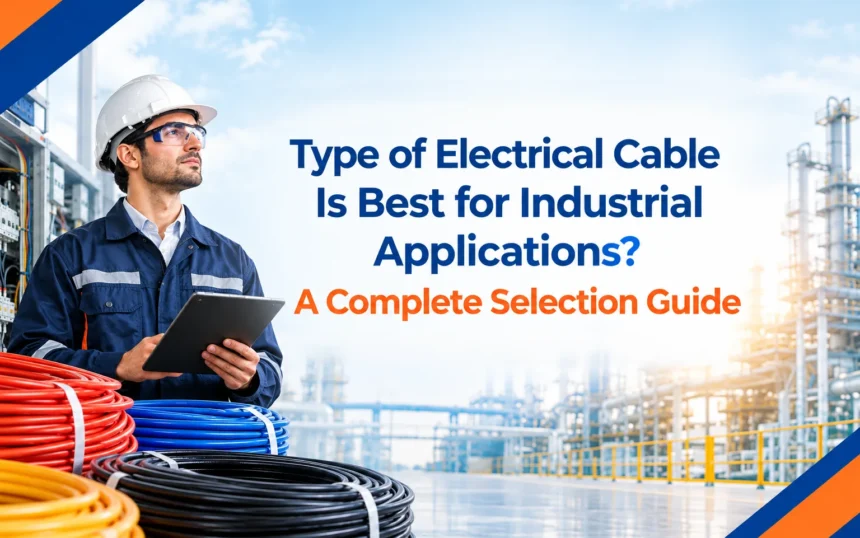
Selecting the appropriate cable for an industrial plant – More than just size There’s a lot more to choosing an industrial plant cable than getting the correct size. The cable needs to suit the electrical load, environment, voltage and temperature.
Whether for power distribution, heavy machinery, automation, or chemical plants, the various applications of industrial electrical cables have different requirements. This guide will explain the primary types of cables and the considerations buyers should take into account before choosing electrical wires and cables for industrial purposes.
What Are Industrial Electrical Cables and How Are They Different From Domestic Cables?
Industrial Electrical Cable Industrial electrical cable is used to transmit electrical power or signals in an industrial setting, such as a manufacturing facility, a substation or processing plant, or infrastructure project.
It may require more current capacity, higher degree of mechanical protection, higher temperature ratings, flexibility, resistance to oil, chemicals, moisture, abrasion and other environmental conditions relative to standard home wiring.
Power cables, control cables, flexible cables, instrumentation cables and specialised cables can be suitable for use in industrial installations, depending on the equipment and conditions of use. Included in BTC’s range of cables are XLPE, PVC, control, flexible, armoured, unarmoured and specialised cables suitable for use in a number of industries.
Types of Industrial Electrical Cables Based on Insulation Material
Data centers run 24×7, which means power cabling has almost no room for failure. A few things matter more here than in a typical commercial or industrial setup:
- PVC Insulated Cables - Cost-Effective General Industrial Wiring
PVC is the preferred material for electrical insulation and sheathing, as it has good electrical properties, is tough and cost effective. PVC cables are recommended for a great deal of fixed power and control applications.
In India, IS 1554 Part 1 describes PVC insulated heavy-duty electric cables for working voltages up to and including 1,100 V. Armoured and unarmoured constructions are included in the Indian standards.
- XLPE Insulated Cables - Higher Load and Heat Capacity
XLPE (cross-linkable polyethylene): XLPE power cables are available on the market to replace PVC insulation, offering a much higher conductor operating temperature rating. In general, XLPE has been expanding into all areas of high-voltage power distribution applications.
XLPE-insulated cables Covered under IS 7098 Part 1 and Part 2 for 1,100 V and above-voltage levels. BIS considers IS 7098 Part 2 for working voltages from 3.3 kV up to 33 kV.
BTC provides unarmoured and armoured XLPE-insulated cables for the power, control and industrial market.
- PTFE/Rubber Insulated Cables - Extreme Heat and Chemical Resistance
PTFE-insulated cable is appropriate for use in high temperature situations, or where chemical exposure is common. Rubber-insulated cables are used for their flexibility and resistance to mechanical damage, or other tough working environments.
The general insulating material should be chosen according to the installation, temperature, chemical resistance, flexibility, voltage, etc., in a way not depending solely on the insulating material.
- Armored vs Unarmored Cables: Which One Fits Your Industrial Site?
Armoured cable is a copper cable with a metallic protective layer to make up for additional protection against physical impacts. It is generally applied to: underground paths, areas with mechanical impacts, industrial cable trenches, and the cable routes with physical protection.
Unarmoured cable is sometimes appropriate when the cable is run through conduit, tray, enclosure or any other conduit where no further protection from mechanical impact is necessary.
The range of BTC’s cable includes the option of armoured and unarmoured construction, permitting an option to suit the installation environment.
Choosing Cables by Voltage Rating: LT vs HT Industrial Cables
LT cables, generic term used in Indian Industry, are used for Low Tension Distribution & Low Tension Equipment Connections. These are covered in IS 1554 Part 1 & IS 7098 Part 1 for up to 1,100 V.
HT cables are suitable for use with higher-voltage power distribution. IS 7098 Part 2, for instance, which is given below, is the specification for XLPE-insulated cables with a working voltages from 3.3 kV to 33 kV.
The cable voltage rating shall be always correct with the electrical system of the area and the project standard applied.
Best Cable Types for Specific Industrial Sectors
- Cables for Manufacturing and Heavy Machinery
Manufacturing plant cable power, control, flexible, servo and specialised machine. Flexible industrial cable is beneficial where the gear involves periodic motion.
Are you looking for cables for CNC machines, machine tools, control systems, assembly lines and machining centres? These cables are all in the catalog BTC.
- Cables for Power Plants and Substations
For power generation and distribution plants, power, control and instrumentation cables should be suitable for the appropriate rating. Power cables insulated with XLPE are widely used for fixed distribution. The voltage and construction depend on the network design.
- Cables for Oil, Gas, and Chemical Industries
These surroundings could involve exposure to chemicals, oil, moisture, heat and fire hazards. Buyers may need specialised sheathing, flame-retardant and low-smoke performance, mechanical guard, and acceptable approval based mostly on the applying.
Key Factors to Consider Before Selecting an Industrial Cable
Before purchasing an industrial wiring cable, evaluate:
- ● Existing capacity: Make sure the conductor is rated for the load you will be putting on it.
- ● Voltage rating: Specify the system voltage so that the correct voltage rating cable can be used.
- ● Temperature: Take into account the internal working temperature of the conductor and the surrounding environment.
- ● Installation: Find out if the cable has to be kept underground, in trays, ducts, conduits or surface.
- ● Mechanical protection: Determine whether armouring is necessary.
Chemical exposure: Choose appropriate materials for your insulator and sheath. - ● Flexibility: Moving machines may demand flexible cable structures.
- ● Voltage Drop: When sizing the conductor, consider cable length and load.
● Standards: Confirm the IS, IEC, or project specification.
Fire Safety and Compliance Standards for Industrial Cables (IS & IEC)
Fire performance is a key factor in choosing industrial cables. Buyers can specify construction options such as FR (Flame Retardant), FRLS/FRLSH and LSZH/LSHF.
There are IS specifications such as IS 1554 that cover PVC insulated, heavy-duty cables; IS 7098 that cover XLPE-insulated cables; and BIS reports showing the tests for flame retardance, smoke density, halogen-acid gases generation, and other qualities of specific cable designs.
On a global scale, the IEC 60502-1 has to do with the constructions, measurements and tests of some power cables that have been extruded-insulation and for use in fixed setups, industrial installations included.
Confirm the appropriate edition and certification rules currently in force for your project.
Common Mistakes to Avoid When Buying Industrial Cables
Some common purchasing mistakes include:
- ● Selecting a cable based only on price.
- ● Undersizing the conductor for the actual load.
- ● Ignoring ambient-temperature and installation derating.
- ● Using unarmoured cable in areas where mechanical protection is necessary.
- ● Overlooking voltage-drop requirements on long cable runs.
- ● Choosing insulation that is non-chemical, resistant to heat and resistant to moisture.
- ● Not checking BIS or relevant certification & testing documentation.
Buying from an unreliable supplier without documented product specification.
Why Choose BTC for Your Industrial Cable Needs ?
Partner with an experienced wires and cables supplier for an easier industrial purchase of wires and cables with a variety of cable constructions, brands, specifications and application categories to select from.
BTC – Bharat Trading Corporation is known as the wholesaler of wires and cabling, cable accessories, switchgear, and other electrical items. Its website shows it sells brands like RR Kabel and products like construction, panels and switchgear, automation, power transmission and distribution, oil and gas, OEMs, railways, airports, data and communication, and renewable energy.
An experienced cable supplier in India is able to guide businesses who need electric wire distributors. An experienced wire distributor will be able to match the conductor size, insulation, voltage rating, armouring and application with the product specification.
If you require industrial wire & cable for machinery, power distribution, control or perhaps a specific industrial environment, it is imperative that you make the correct choice – Engineering criteria rather than price.
Frequently Asked Questions
Q1: What cable is suitable for high-temperature industrial environments?
The cable should be chosen for the correct temperature and application. PTFE, specialised elastomer or other high temperature constructions should be used where standard PVC or XLPE is not applicable.
Q2: So what is the difference between LT and HT cable?
LT cables are intended for low volt distribution and HT cables will be used for high voltage power systems which have to be tested and insulated.
Q3: How long do industrial cables typically last?
The service life of any given industrial cable is dependent on cable construction, loading, temperature, environment, installation quality, and maintenance. There is not one set number of years in which all industrial cables will last.
Q4: Is armored cable necessary for indoor installations?
Not necessarily. Armouring is determined by the risk of mechanical damage and the method of installation. Some protected indoor cable routes may not be armoured.
Q5. How do I know what certs to look for?
Verify the relevant BIS/IS or IEC standard, manufacturers test records, voltage rating, construction specifications and fire performance certifications required.