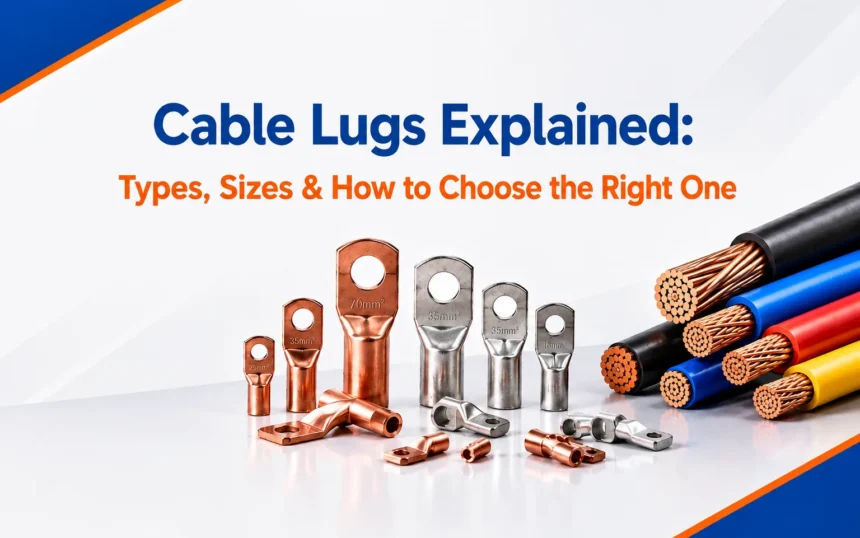
Cable Lugs Explained: Types, Sizes & How to Choose the Right One
If you have ever opened an electrical panel and looked at where the cables terminate, you have seen cable lugs at work. They are small components, but they carry the full weight of the current running through your system literally. A poorly chosen or badly crimped lug is one of the most common (and most avoidable) causes of loose connections, overheating, and panel failures.
At BTC (Bharat Trading Corporation), we supply cable lugs, cable terminal ends, and cable glands to panel builders, contractors, OEMs, and industrial buyers across India, as an authorised dealer and distributor for Jainson. In this guide, we break down the different types of cable lugs and terminal ends, where cable glands fit into the picture, and how to choose the right combination for your application.
What Is a Cable Lug?
A cable lug (also called a cable terminal end) is a metal fitting crimped or soldered onto the end of a cable to allow it to be safely and securely connected to a terminal, busbar, stud, or piece of equipment. Instead of exposing bare stranded conductor to a screw or bolt which can fray, loosen, or make poor contact a lug gives the cable a solid, properly shaped termination point.
Lugs matter because the termination point is often the weakest link in a circuit. A well-made lug, correctly sized for the cable and crimped with the right tool, maintains low resistance and a stable mechanical grip over years of vibration, heat cycling, and load changes. This is why choosing the right type, material, and size of lug is not a minor detail it directly affects the safety and reliability of the connection.
Types of Cable Lugs and Terminal Ends
BTC stocks a wide range of Jainson cable terminal ends, covering the shapes and configurations used across control panels, switchgear, motors, and general wiring work.
Ring tongue terminals are manufactured from high-conductivity copper and are electro-tinned for corrosion resistance. The closed-ring design means the terminal cannot slip off the stud even if the screw loosens slightly, which makes this one of the most widely used lug types wherever a secure, permanent connection to a bolted terminal is needed.
Fork (or spade) type terminal ends are used for the same kind of applications as ring tongues — termination of control cables, flexible cords, and connections inside control panel cubicles — but with an open-ended design. This allows the terminal to be removed or repositioned without fully unscrewing the terminal screw, which is useful where cables need to be disconnected periodically for maintenance.
Pin type terminal ends come in round and flat variants and are mainly used for control cables and flexible cords, typically in smaller conductor sizes. They are suited to terminal blocks and connectors where the cable needs to be inserted into a socket-style terminal rather than bolted down.
Tubular terminal ends are among the most commonly used terminal types, made for both crimping and soldering applications. Their straightforward barrel construction makes them a practical, general-purpose choice for a wide range of copper cable terminations.
Reducer type terminal ends (also supplied as copper pin terminals) are designed for cables entering copper tunnel clamps for example, on fine-gear connections, cut-out meters, and energy meters. They allow a larger lug body to reduce down to a smaller pin size where the equipment terminal calls for it.
Manufactured from phosphorus bronze, snap-on terminal ends are available in insulated versions with metal reinforcement. Their push-fit design suits applications where quick, tool-free connection and disconnection is preferred over a bolted terminal.
- In-Line Connectors & Ferrules
In-line connectors and ferrules are manufactured from soft drawn bare copper tube (as per BS-1977) and aluminium (as per IS 5082) to achieve high electrical and mechanical strength. These are used to join two cable ends in-line, rather than terminating a cable at a stud or terminal block.
- Ferrules (Crimping Type)
Separately, BTC also stocks crimping-type insulated ferrules (ranging from 0.5–95 mm²) and twin cord end insulated terminals (0.5–16 mm²). These are the small, colour-coded sleeves used to prepare flexible/stranded wire ends before inserting them into terminal blocks, ensuring the fine strands don’t splay out or loosen under the terminal screw.
- Bi-Metallic Lugs
Where an aluminium cable needs to be connected to a copper busbar or terminal (or vice versa), a bi-metallic lug is used to prevent the galvanic corrosion that occurs when dissimilar metals are joined directly. BTC’s Jainson bi-metallic lug range covers:
- ● Round Palm Bimetallic Lugs – 16 sq mm to 630 sq mm
- ● Reverse Bimetallic Lugs – 16 sq mm to 630 sq mm
- ● Copper Ring Bimetallic Lugs – 16 sq mm to 630 sq mm
- ● Square Palm Bimetallic Lugs – 70 sq mm to 630 sq mm
- ● Pin Reducer Bimetallic types
You can browse the complete range on our Cable Terminal Ends category page.
Copper Cable Lugs vs Aluminium Cable Lugs
One of the first decisions when specifying lugs is matching the lug material to the cable conductor.
Typical applications include
- Copper cable lugs are used with copper conductors and offer excellent conductivity and a well-established track record in control panels, machine wiring, and general LV installations. Most of BTC's tubular, ring tongue, fork, pin, and reducer type terminal ends are manufactured from high-conductivity copper.
- Aluminium cable lugs are used where the cable itself is aluminium common in larger power cables used for feeder and distribution work, where aluminium's lighter weight and cost profile make it a practical choice for bigger conductor sizes.
- The catch copper and aluminium should never be joined directly at a terminal. The two metals have different electrochemical properties, and over time, moisture at the joint sets up galvanic corrosion that increases resistance and can eventually cause the joint to fail or overheat. This is exactly why bi-metallic lugs exist they have a copper section on one side and an aluminium section on the other, joined in a way that keeps each metal in contact only with cable of the same type, while still letting you connect an aluminium cable through to a copper busbar or stud safely.
If your installation mixes aluminium feeder cable with copper panel terminals or busbars a very common scenario in distribution and industrial wiring a bi-metallic lug is the correct component to specify, not a straight copper or aluminium lug.
Cable Lug Sizes: Matching Lug to Cable
Cable lugs are sized by cross-sectional area (sq mm / mm²), and the lug size must match the cable’s conductor size, not the cable’s overall outer diameter. BTC’s bi-metallic lug range, for example, spans from 16 sq mm up to 630 sq mm, covering everything from smaller control and lighting circuits through to heavy power cables used in distribution and industrial feeders. Ferrules for flexible/stranded wire cover a finer range, from 0.5 mm² up to 95 mm², suited to control wiring, instrumentation, and panel-internal connections rather than heavy power cables.
A few practical points to keep in mind when sizing a lug:
- Undersized lugs won't accept the full strand bundle of the cable, forcing strands to be cut or left outside the barrel both of which increase resistance and heat at the joint.
- Oversized lugs leave gaps inside the barrel after crimping, so the crimp cannot achieve a solid mechanical and electrical bond.
- The stud/hole size on the lug's palm or ring must match the terminal, busbar stud, or bolt it will be fastened to; this is independent of the cable-side barrel size.
Always crimp with a tool rated for the lug type and size range BTC also supplies manual and hydraulic crimping tools from Ashwin Tools for insulated and non-insulated terminals and lugs.
Where Cable Glands Fit In
Cable lugs and cable glands are often specified together, but they do different jobs. A lug terminates the conductor at a connection point; a cable gland is fitted where the cable enters an enclosure, panel, junction box, or piece of equipment, and its job is to grip the cable, maintain the enclosure’s ingress protection rating, and in many industrial settings provide earth continuity.
BTC’s Jainson Cable Glands range includes:
- Single Compression Cable Glands (including the Heavy Duty SIBG type, Siemens Type, and Siemens Type Long Nipple) a single sealing ring grips the cable's outer sheath as it enters the enclosure.
- Double Compression Cable Glands include flameproof types (light duty and heavy duty/weatherproof) with two sealing points, one on the outer sheath and one on the inner bedding or armour, giving a more robust seal for harsher or hazardous environments.
- Flange Type Brass Cable Gland designed for flange-mounted entry rather than a standard threaded gland plate hole.
- Cable Gland Accessories including brass earth tags, used to maintain earth continuity between the gland and the equipment it is mounted on.
- Industrial automated uses.
BTC’s cable glands are manufactured from brass (as per IS 12943), typically with a nickel-plated standard finish (tin, cadmium, or chrome finishes also available), and threads in BSC-standard, with PG, NPT, and BSP options depending on the specific gland.
Cable Lugs and Glands Working Together
In a typical panel or enclosure entry, the cable comes in through the gland (which anchors and seals it at the enclosure wall), runs to its termination point, and ends in a lug (which connects it to the terminal, busbar, or stud). Getting both right correct gland type and size for the enclosure and cable, correct lug type, material, and size for the conductor and connection point is what keeps a panel both electrically sound and properly protected against dust, moisture, and mechanical strain at the cable entry.
How to Choose the Right Cable Lug or Gland
When specifying lugs and glands for a job, it helps to work through these questions in order:
- What is the conductor material? Copper cable calls for a copper lug; aluminium cable calls for an aluminium-rated lug or, where it terminates on a copper busbar or stud, a bi-metallic lug.
- What is the cable's cross-sectional area? Match the lug's barrel size to the cable's conductor size (sq mm), not the outer cable diameter.
- What does the lug connect to? A bolted stud or busbar generally calls for a ring tongue, fork, or palm-type lug; a terminal block or socket calls for a pin type or ferrule.
- Does it need to be removable? Snap-on or fork type terminals allow quicker disconnection for maintenance; ring tongue types are more secure but need the screw removed to disconnect.
- Where does the cable enter the enclosure, and under what conditions? A standard indoor panel usually suits a single compression gland; outdoor, hazardous, or high-vibration locations typically call for a double compression or flameproof type gland.
- What ingress and earthing requirements apply? Confirm whether the installation needs earth continuity tags at the gland, and select the gland's finish and thread type to match the enclosure and application.
If you’re unsure which combination fits your project, our team can help you work through the specification based on your cable, panel, and site conditions.
Get the Right Lugs and Glands for Your Project
Choosing the correct cable lug, terminal end, or cable gland comes down to matching material, size, and type to your cable and application to get
it right, and it’s one less thing to worry about in your panel or installation. As an authorized Lugs & Gland Jainson dealer and distributor, BTC stocks the complete range of copper and aluminium (bi-metallic) cable lugs, terminal ends, ferrules, and single/double compression cable glands from our Pune base, with pan-India supply for panel builders, contractors, and OEMs.
Browse our full Lugs & Gland range, or get in touch with BTC for help specifying the right lugs and glands for your next project.
Frequently Asked Questions
Q1: What is the difference between a cable lug and a cable gland?
A cable lug terminates the conductor at a connection point (a stud, busbar, or terminal block). A cable gland is fitted where the cable enters an enclosure, and its job is to grip and seal the cable and, where required, maintain earth continuity with the enclosure.
Q2: Can I use a copper lug on an aluminium cable?
No joining copper and aluminium directly at a terminal leads to galvanic corrosion over time, which increases resistance and can cause the joint to fail. Use a bi-metallic lug wherever an aluminium cable needs to terminate on copper, or vice versa.
Q3: How do I know what size cable lug I need?
Match the lug’s barrel size to the cable’s conductor cross-sectional area in sq mm, and make sure the palm or ring’s hole size matches the stud, bolt, or busbar it will be fastened to.
Q4: What's the difference between single compression and double compression cable glands?
Yes. BTC is an electrical wholesale distributor equipped for bulk supply to OEMs, panel builders, and equipment manufacturers, with dedicated bulk order and distributor/dealer enquiry channels.
Q5: Does BTC supply crimping tools along with lugs?
Yes. Alongside our Jainson lugs, terminal ends, and cable glands, we also supply manual and hydraulic crimping tools, wire strippers, and cable cutters from Ashwin Tools, so you can source the terminations and the tools to fit them correctly in one place.