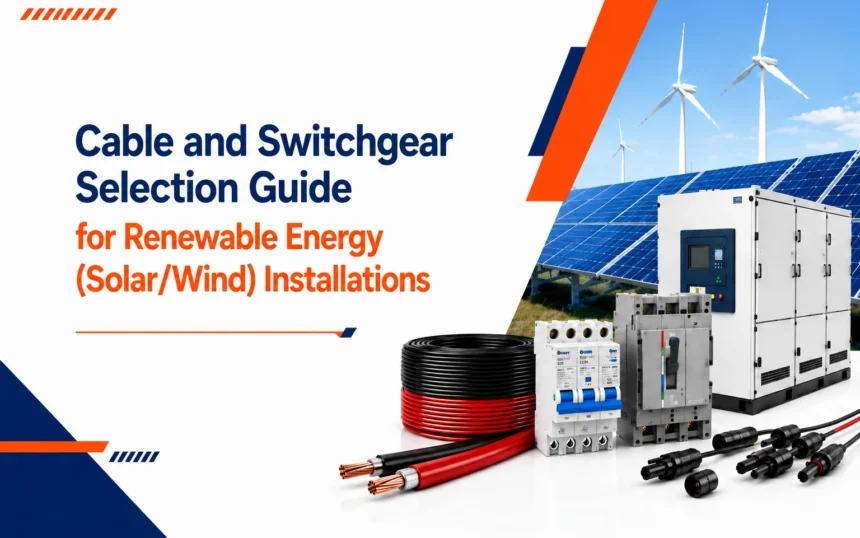
Behind every solar farm or wind turbine, there’s a hidden network of wires and cables and switchgear that keeps power flowing safely from generation to grid. While panels and turbines get most of the attention, it’s the electrical infrastructure around them, cables, terminations, and switchgear, that determines whether a renewable energy plant runs reliably for 20-25 years or runs into repeated faults and downtime.
At Bharat Trading Corporation (BTC), a wires and cables and switchgear supplier based in Pune, we work closely with solar EPC contractors, wind turbine manufacturers, and renewable energy developers across India to help them select the right electrical components for their projects. This guide walks through what to look for when selecting cables and switchgear for solar and wind installations, based on the product categories and industry expertise Bharat Trading Corporation offers.
Why Cable and Switchgear Selection Matters in Renewable Projects
Solar panels and wind turbines are designed to operate outdoors for decades, but they can only perform as well as the electrical system supporting them. Renewable plants deal with constant sunlight, temperature swings, rain, dust, vibration, and in some cases high humidity or salt exposure. If the wires and cables or switchgear used aren’t built for these conditions, the result is voltage loss, insulation failure, or unplanned shutdowns.
Getting cable and switchgear selection right the first time protects the investment, reduces maintenance visits, and keeps energy flowing without interruption, which is exactly why BTC positions itself as a dependable cable for renewable energy industry and switchgear supplier for solar, wind, hydro, and hybrid projects.
How Power Moves Through a Renewable Energy System
Understanding where cables and switchgear fit into a renewable plant makes selection easier. Here’s the general flow:
- Power Generation – Solar panels capture sunlight and wind turbines convert wind movement into raw electrical energy.
- DC Collection and Wiring – In solar plants, this power is DC. Solar DC cables carry it from the panels to combiner boxes or converters, so cable quality here directly affects voltage loss and safety.
- Conversion – Inverters (solar) or turbine controllers (wind) convert DC power to AC to match grid and equipment requirements.
- AC Power Distribution – Once converted, electricity moves through armoured or heavy-duty power cables to switchgear, breakers, control panels, and transformers for further distribution or voltage adjustment. This is where switchgear plays its central role, controlling, protecting, and isolating circuits so faults don’t cascade through the plant.
- Monitoring and Automation – SCADA systems and control panels rely on control and instrumentation cables to track performance and manage automation in real time.
- Storage or Grid Export – The generated energy is either stored in battery systems or exported to the grid, both of which depend on secure, well-terminated wiring.
Every one of these stages needs a specific type of cable or protective component, which is why a one-size-fits-all approach to wiring rarely works in renewable projects.
Cable Selection Guide for Solar and Wind Installations
Bharat Trading Corporation supplies a complete range of wires and cables suited to different stages of a renewable installation.
Solar DC cables are purpose-built for photovoltaic wiring. They’re designed to withstand high DC voltage, constant UV exposure, and extreme outdoor weather, making them suitable for long-term use between panels, combiner boxes, and inverters. Explore Solar DC Cables →
- Armoured and Unarmoured Power Cables
Once power is converted to AC, it needs to move safely through the plant. Armoured and unarmoured power cables are used for AC power distribution, transformer connections, and main supply lines. Armoured versions add mechanical protection for underground or exposed runs. View Power Cables →
- Control and Instrumentation Cables
Modern solar and wind plants rely on automation to run efficiently. Control and instrumentation cables support SCADA systems, control panels, and communication networks, keeping monitoring and plant operations accurate. Explore Control Cables
- Choosing Between Copper and Aluminium
Copper cables offer higher conductivity and lower resistance, which makes them a strong choice where efficiency and compact sizing matter most. Aluminium cables, on the other hand, are lighter and more cost-effective, which makes them practical for long cable runs across large solar farms where budget optimisation is a priority.
- Fire Safety: FRLS vs. LSZH
For installations where fire safety is a concern, such as rooftop solar or enclosed plant rooms, Flame Retardant Low Smoke (FRLS) cables limit flame spread and reduce smoke. Low Smoke Zero Halogen (LSZH) cables go a step further, releasing minimal smoke and no halogen gases, making them suitable for enclosed spaces and critical infrastructure where occupant safety matters most.
Terminations and Protective Accessories
Cables are only as reliable as their terminations and protective fittings. BTC’s renewable energy product range also covers:
- ● Cable Lugs and Cable Glands (copper and aluminium) – used in inverters, panels, and distribution systems to create secure, vibration-resistant, long-lasting connections.
- ● Heat Shrink Sleeves and Insulation Kits – provide weatherproof sealing and added protection against moisture and dust in outdoor installations.
- ● Cable Management Systems – including trays, ducts, conduits, clamps, and ties that keep wiring organised, easier to maintain, and compliant with safety standards.
Switchgear Selection Guide for Renewable Installations
Once AC power leaves the inverter or turbine controller, it passes through switchgear before reaching transformers or the grid. Switchgear is the equipment that controls, protects, and isolates circuits, allowing operators to safely de-energise sections of the plant for maintenance or clear faults without disrupting the entire system.
For panels and switchgear needs, Bharat Trading Corporation supplies switchgear through Schneider Electric, one of the brands in BTC’s portfolio, giving renewable energy developers, EPC contractors, and panel builders a dependable switchgear supplier alongside their cabling requirements. Because cabling and switchgear are sourced together, project teams can plan AC distribution, protection, and control as a single, coordinated system rather than sourcing components from multiple vendors.
When selecting switchgear for a solar or wind project, the same environmental factors that affect cable choice apply: outdoor exposure, temperature variation, and in some cases dust or moisture ingress, so switchgear should be matched to the panel or enclosure conditions on site, just as cable insulation is matched to the installation environment.
Where BTC’s Products Are Used Across Renewable Applications
| Application Area | Typical Use Cases |
|---|---|
| Solar Energy Systems | PV module to combiner box connections, DC cabling between panels and inverters, inverter-to-AC panel cabling, earthing and grounding, solar tracking motor wiring, rooftop safety wiring, solar water pumping |
| Wind Energy Systems | Nacelle and rotor wiring, tower power circuits, turbine control panels, outdoor substations, monitoring and communication systems |
| Hydropower Plants | Generator control wiring, panel cabling in humid areas, pump and motor connections, instrumentation and monitoring |
| Biomass & Waste-to-Energy | Boiler control wiring, emission monitoring systems, turbine power distribution, high-temperature zones |
| Hybrid Microgrids & Energy Storage | Battery connection circuits, control and monitoring cables, DC/AC integration wiring |
Key Challenges in Renewable Energy Electrical Infrastructure
- Constant outdoor exposure - Sunlight, heat, rain, and dust can crack or degrade poor-quality cable insulation over time.
- High DC voltage in solar plants - Most solar systems operate between 600V and 1500V DC, which puts significant stress on cables and connectors, making high-purity copper and proper insulation important.
- Vibration in wind turbines - Continuous blade rotation and tower movement demand flexible, vibration-resistant cabling.
- Moisture in hydropower plants - Humid, water-rich environments require properly insulated and waterproof components to avoid short circuits.
- Corrosion near biomass or coastal sites - Salt-laden air and chemical exposure can accelerate corrosion without protective materials.
- Long cable runs in large solar farms - Extended distances increase the risk of voltage drop, making low-loss, armoured cables important for large installations.
Who Relies on These Cable and Switchgear Solutions
- Solar EPC Contractors need dependable DC solar cables, secure terminations, and efficient AC power distribution components.
- Wind Turbine Manufacturers require flexible, vibration-resistant cabling that can handle constant mechanical movement.
- Renewable Energy Developers need complete cabling solutions for power transmission, control systems, and grounding across large-scale projects.
- Hydropower Authorities need waterproof cables and strong insulation for moisture-heavy environments.
- Commercial and Industrial Rooftop Installers prioritise fire-safe FRLS wiring and organised cable management.
- Battery Energy Storage System (ESS) Integrators need high-current DC wiring and protective accessories to manage stored energy safely.
Choosing the Right Partner for Cables and Switchgear
Selecting cables and switchgear for a renewable energy project isn’t just about picking a wire size or a panel rating, it’s about matching every component to the environment, voltage, and long service life the plant is expected to deliver. As a renewable energy sector wire and cable supplier and switchgear supplier, Bharat Trading Corporation brings together solar DC cables, armoured power cables, control cabling, terminations, and Schneider Electric switchgear under one roof, helping solar and wind project teams source what they need without compromising on reliability.
If you’re planning a solar, wind, or hybrid renewable project and need help selecting the right cables and switchgear, get in touch with BTC or explore the full renewable energy product range to find components matched to your installation.
Frequently Asked Questions
Q1: What type of cables are best suited for solar power plants?
Solar DC double-insulated cables are the standard choice for connecting panels and handling high DC voltage safely, while XLPE armoured AC cables are commonly used for distribution from the inverter to transformers or panels.
Q2: Why does UV resistance matter for renewable energy cables?
Solar and wind installations are exposed to direct sunlight for years. UV-resistant insulation prevents cracking and deterioration, extending cable life and reliability.
Q3: Can aluminium cables be used in solar farms?
Yes. Aluminium armoured cables are widely used for long-distance AC power transmission within large solar farms, as they are lighter and more cost-effective than copper for utility-scale projects.
Q4: What accessories are essential alongside cables in a renewable installation?
Cable lugs for secure terminations, cable glands for sealing and protection, heat-shrink sleeves for insulation, and cable trays or management systems for organised, compliant installations.
Q5: How long do renewable energy cables and switchgear typically last?
When properly selected and installed, cables and switchgear are built to match the 20-25 year lifespan of solar panels and wind systems, though regular inspection helps maintain performance over time.