
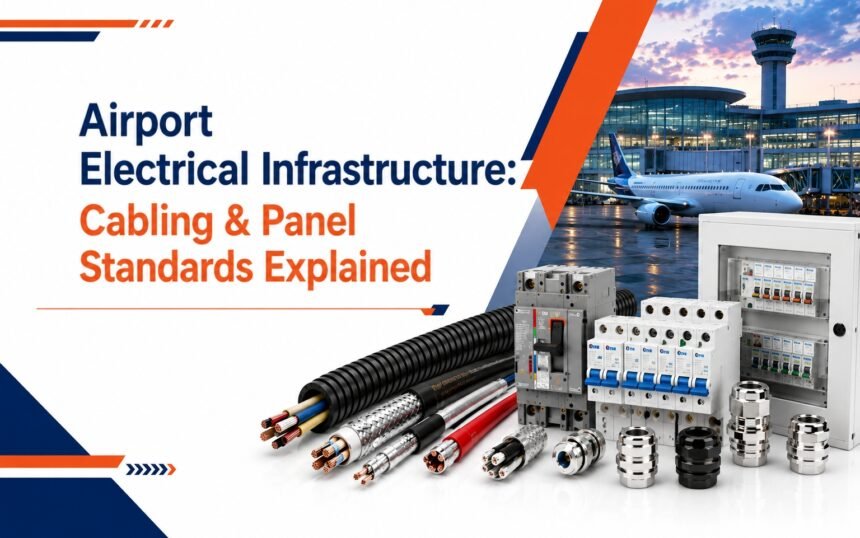
Airports run around the clock, and almost everything inside one from runway edge lights to the check-in counter screens depends on an electrical backbone that simply cannot fail. Terminals, control towers, baggage handling systems, aprons, and back-of-house utility rooms all draw on the same requirement: cabling and panel systems that are rated for continuous duty, safe in crowded public spaces, and built to hold up under years of round-the-clock operation.
At Bharat Trading Company (BTC), we work as an electrical wire supplier and distributor for exactly this kind of demanding infrastructure supplying wires and cables, switchgear, terminal blocks, panel accessories, and cable management products to contractors, panel builders, and facility teams handling large public-infrastructure projects. This guide walks through what airport electrical infrastructure actually involves, the cabling and panel standards that matter most, and where BTC’s product range fits into these projects.
What Goes Into Airport Electrical Infrastructure?
Airport electrical systems aren’t a single network they’re several interconnected systems working together: passenger terminal power and lighting, runway and apron lighting circuits, baggage handling and conveyor wiring, HVAC and fire safety systems, control tower and communication wiring, and the distribution panels and switchgear that tie it all together. Each of these zones has its own operating conditions, some indoor and climate-controlled, some fully exposed to weather on the airside which is why cable selection and panel design have to be matched to the specific environment rather than treated as one uniform spec.
Cabling Requirements for Airport Facilities
Cabling is the most visible part of any airport electrical project, and it’s also where getting the specification wrong causes the most long-term trouble. A few requirements come up again and again on airport and large-infrastructure projects:
- ● Power cables for main supply lines, transformer connections, and distribution feeds typically armoured cables for underground or exposed runs, and unarmoured cables for protected indoor routing.
- ● Control and instrumentation cables for baggage handling systems, HVAC controls, and building management/monitoring systems, where accurate signal transmission matters as much as power delivery.
- ● Fire-safe cable options, such as FRLS (Flame Retardant Low Smoke) and LSZH (Low Smoke Zero Halogen) constructions, which are especially relevant in enclosed public spaces like terminal concourses, tunnels, and equipment rooms, where limiting smoke and toxic gas in the event of a fire is critical for evacuation safety.
- ● Weather-resistant cabling for airside applications apron lighting, ground equipment power points, and outdoor distribution that has to withstand sun, rain, and temperature swings over a long service life.
Bharat Trading Corporation supplies this range through its Wires & Cables category, including RR Kabel and Dynamic Cable power and control cables, along with PTFE cable options for higher-temperature or specialised wiring needs. For teams sourcing at scale, our dedicated Wires and Cables Supplier page covers our aluminium, armoured, and flexible cable range in more detail.
Panel & Switchgear Standards for Airports
Cabling is only half the picture the panels and switchgear it connects to are what actually protect the system and keep power flowing safely. Airport-grade panel work generally needs to account for:
- ● Reliable switchgear for protection, isolation, and load management across distribution boards and sub-panels. BTC supplies Schneider Electric switchgear for this purpose, covering the protection and control needs of panel builders working on large facilities.
- ● Terminal blocks for organised, secure wire termination inside control and distribution panels an area where poor-quality components lead to loose connections and nuisance faults down the line. Our Terminal Blocks range includes Connectwell and Suraj Electronics products.
- ● Panel accessories, including DIN rail components and internal hardware, from Shree Gopal Industries and Connectwell, used to keep panel interiors organised and serviceable.
- ● Relay modules for control and automation logic within panels, such as our Connectwell Relay Module range, which supports the kind of automated monitoring and control systems airport facility teams increasingly rely on.
- ● Enclosures, to physically protect panel internals in equipment rooms, outdoor cabinets, and back-of-house areas available through our Enclosure category.
Where These Systems Come Together in an Airport
- Terminal buildings - lighting, HVAC power, retail and check-in circuits, and passenger information systems, all requiring dependable indoor power cabling and well-organised panels.
- Baggage handling areas - continuous-duty control and instrumentation wiring for conveyors and sorting systems, where downtime has an immediate operational impact.
- Airside and apron areas - weather-resistant power cabling for lighting and ground support equipment, exposed to sun, rain, and constant vibration from vehicle movement.
- Control towers and communication rooms - precise, well-shielded wiring for systems where signal accuracy is non-negotiable
- Back-of-house utility and plant rooms - the distribution panels, switchgear, and cable management systems that tie the entire facility's power supply together.
- Long cable runs in large solar farms - Extended distances increase the risk of voltage drop, making low-loss, armoured cables important for large installations.
Key Challenges in Airport Electrical Projects
- Continuous, uninterrupted operation. Airports don't have an off-season or an off-hour. Cables and panel components are under near-constant load, which means insulation quality and connection integrity have to hold up over years of continuous duty, not just pass an initial test.
- Fire safety in enclosed public spaces. Terminals, tunnels, and underground areas are high-occupancy public spaces, so the case for FRLS and LSZH cabling is strong wherever wiring runs through enclosed or crowded zones.
- Mixed indoor and outdoor exposure A single airport project can call for indoor-rated control cabling in the terminal and weather-resistant armoured cabling on the apron sourcing both from one supplier keeps specifications consistent and simplifies procurement.
- Organised, serviceable panel work With dozens of distribution boards and control panels across a facility, panels built with reliable terminal blocks and clearly organised accessories are significantly easier and safer to maintain over the long term.
What BTC Supplies for Airport & Large-Infrastructure Projects
- ● Wires & Cables – power, control, and instrumentation cables (RR Kabel, Dynamic Cable, PTFE, Shree Gopal Industries)
- ● Switchgear – Schneider Electric protection and control products
- ● Terminal Blocks – Connectwell and Suraj Electronics
- ● Panel Accessory – DIN rail and panel hardware
- ● Cable Ducts and Cable Tie – organised cable routing and management
- ● Lugs & Gland – Jainson terminations and sealing accessories
- ● Enclosure – panel and equipment protection
- ● Led & Lighting – Arraystrom and RR Lighting fixtures for terminal and facility lighting
Why Work With BTC as Your Airport Industry Electrical Cable Supplier
Bharat Trading Corporation operates as a dealer and distributor of electrical wires, cables, switchgear, and panel accessories, working with established brands rather than unbranded or unverified stock. For contractors and panel builders sourcing for airport and other large public-infrastructure projects, that means one point of contact for cabling, switchgear, terminations, and cable management instead of coordinating multiple vendors for a single panel or distribution board. Our team can help match the right cable and panel components to a project’s specific indoor, outdoor, or fire-safety requirements.
Frequently Asked Questions
Q1. What type of cables are used in airport electrical systems?
Airport projects typically use a mix of armoured and unarmoured power cables for distribution, control and instrumentation cables for automated systems like baggage handling, and fire-safe FRLS or LSZH cables in enclosed public areas such as terminal concourses and tunnels.
Q2. Why is fire-retardant cabling important in airports?
Terminals and enclosed areas like tunnels handle large volumes of people at once. FRLS and LSZH cables are designed to limit flame spread and reduce smoke and toxic gas release, which supports safer evacuation conditions if a fire does occur.
Q3. What kind of switchgear is needed for airport panels?
Airport distribution boards and control panels typically need reliable low-voltage switchgear for protection and isolation, along with well-organised terminal blocks and panel accessories to keep wiring secure and serviceable.
Q4. Can the same cable be used both indoors and on the apron?
Not usually. Indoor terminal cabling is generally chosen for fire safety and space constraints, while apron and airside cabling needs to be weather- and UV-resistant to handle constant outdoor exposure. Matching the cable to the environment is important for long-term reliability.
Q5. Who typically sources cabling and panel components for airport projects?
Electrical contractors, panel builders, and MEP (mechanical, electrical, plumbing) consultants working on terminal, baggage handling, or airside infrastructure projects are the main buyers, often sourcing cabling, switchgear, and panel accessories together to keep specifications consistent across a project.