
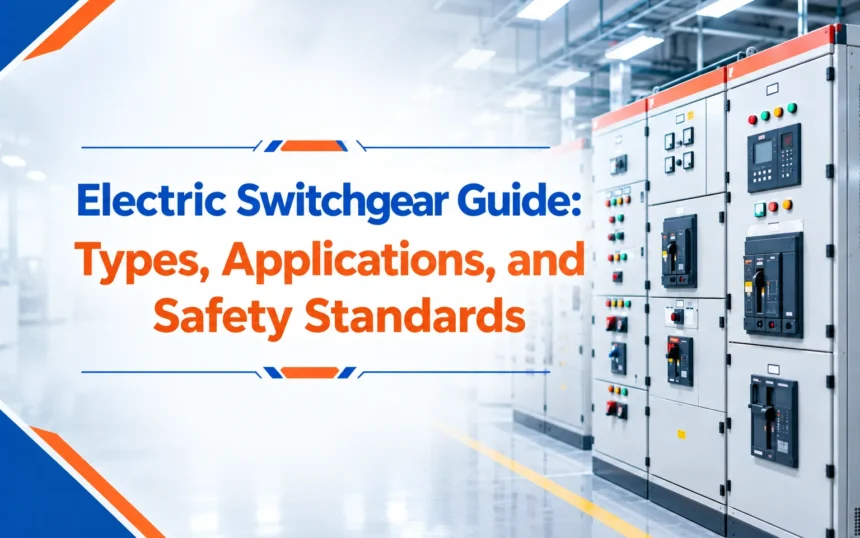
Electrical power systems require more than just cables and transformers to be safe to work with. That is where switchgear can be used. Switchgear combines switching, protection, isolation, monitoring, and control equipment that safely directs the flow of electrical power and helps protect the equipment connected to it from damage and faults. Common applications for switchgear include commercial facilities, substations, and industrial plants.
What Is Electrical Switchgear and Why Does It Matter?
An electrical switchgear is a combination of apparatuses used for switching, controlling, and protecting electrical circuits. It may consist of circuit breakers, switches, isolators, fuses, protection relays, busbars, and metering equipment, among others, which vary according to the use.
Its intended purpose is to isolate a problematic section of a network to prevent damage to equipment, electrical hazards and inconvenience.
Contemporary industrial switchgear may include monitoring and controlling features and therefore be employed in automated power distribution applications. Control switchgear is especially significant in situations where operators require the ability to monitor circuits, feeders, motors, and other loads.
Types of Electrical Switchgear Based on Voltage (LV, MV, HV Explained)
The common division of switchgear is based on the voltage:
- Low Voltage (LV): This is used for systems usually up to 1,000 V AC or 1,500 V DC. LV switchgear finds application in supermarkets, factories, distribution boards and machine control systems.
- Medium Voltage (MV): Usually preceded by systems > 1 kV and up into the tens of kilovolt range. The most common distribution feeders in the field are 11 kV, 22 kV and 33 kV systems. MV switchgear is found in manufacturing plants, sub stations, utility distribution and large commercial loads.
- High Voltage (HV): For higher-voltage transmission and sub-transmission networks. However the point of demarcation may be different depending on the standard and utility practice.
Always consider the rated voltage, the system insulation, the short-circuit level and, if exist, the standards.
Types of Switchgear Based on Design and Installation
Another way to categorise the various switchgear types is to sort them by their installation and construction.
Indoor switchgear is placed in the electrical room or a controlled environment. Ideal for conditions where resistance to weather, dust and moisture is necessary.
Outdoor switchgear is built to withstand the elements and is generally found in utility and substation applications.
Switchgear can also be: Fixed type: Components are hard mounted within the assembly. Draw-out type: Some devices are designed so they can be removed, e.g., for inspection, testing or maintenance, without the need to remove the entire assembly (switchgear panel).
It will be determined by available space, maintenance, and other operation factors, plus site requirements.
Key Applications of Switchgear in Industrial and Commercial Power Distribution
Switchgear is applied whenever electrical power must be controlled and protected.
In factories, it can safeguard feeding units, engines, transformers and production devices. In commercial structures, it’s used to control incoming energy and move power securely to lights, HVAC, elevators, and different loads.
Power generation plants and substations also use higher-rated switchgear to switch and protect transformers, feeders, busbars and distribution networks.
Other applications include hospitals, data centres, process industries, oil and gas, renewable-energy sites, airports and rail infrastructure.
How Does Switchgear Protect Your Electrical System From Faults?
An electrical fault occurs in the form of a short circuit, overload and earth fault. The faults result in excessive current which can be life threatening. Protection devices in switchgear identify the fault and isolate the circuit.
Circuit breakers are designed to automatically disconnect the current flow in the event of a fault. Switch is for switching and isolating operation.
Protection relays read electrical quantities and trip the breaker when certain conditions are met. Isolators offer a visible or defined form of disconnect so that the plant can be de-energised for maintenance purposes.
Combined, these parts help prevent the spread of faults and provide protection to individuals, as well as cables, transformers, motors and other electrical equipment.
Electrical Switchgear Safety Standards You Should Know (IS & IEC)
Adherence to relevant standards is a key consideration when choosing switchgear.
Regarding low-voltage assemblies, IEC 61439 defines requirements for low-voltage switchgear and controlgear assemblies. IEC 61439-2 deals with power switchgear and controlgear assemblies.For Metal-enclosed AC switchgear and controlgear above 1 kV and up to 52 kV IEC 62271-200.
Similarly, when buying electrical appliances in India, IS/IEC standards and BIS specifications are also effective. For instance, IS/IEC 60947-2 for low-voltage circuit breaker is one of the applicable certification standards specified by BIS.
Arc-flash protection is another requirement. Devices should be specified according to the prospective fault level, internal-arc requirements (if any), the conditions of operation and safety procedures adopted by qualified persons.
How to Choose the Right Switchgear for Your Facility ?
Consider these factors before selecting switchgear:
- ● Voltage rating: use appropriate with system voltage.
- ● Existing rating: Choose the equipment in light of repeated load demands.
- ● Short-circuit rating: Know the intended fault current for the location of the installation.
- ● Location where installation is to be made: Indoor or outdoor, temp., Humidity, Dust, Corrosive conditions, etc.
- ● Maintenance needed: Draw-out arrangements are suitable for applications that require regular inspection or replacement.
- ● Protection and control: Determine the needed relays, breakers, metering, automation, and communications.
- ● Standards and certification: Verify conformance with the relevant IS, IEC and project standards.
- ● Supplier support: Is the product regularly available? Can I get my questions answered and appropriate documentation, tools and spare parts?
Why Choose BTC as Your Switchgear Supplier ?
Selecting an Electrical Switchgear Supplier can be equally essential to selecting the product. Used for commercial and industrial applications, BTC deals in electrical products and also includes the switchgear in the list of its products.
BTC also features Schneider Electric as one of its brands and highlights the Schneider Electric products on its list of supplies. Construction, panels and switchgears, automation and process controls, power transmission and distribution, food and beverage, OEMs, oil and gas, automobiles, airports, rail, data and communication, and renewable energy.
If you’re a business that’s looking to source Schneider Electric Switchgear and other Electrical products BTC is able to facilitate product sourcing, utilizing our electrical distribution portfolio and enquiry based sales approach.
Frequently Asked Questions
Q1: Why is a switchgear used?
It safeguards, controls and isolates power, but in addition, it assists with trouble-free operation.
Q2: What is the difference between LV and MV switchgear?
LV switchgear is typically used up to 1,000 volts AC. MV switchgear is used for higher distribution voltages.
Q3: How long does switchgear last?
The service life is based on the design, operating conditions, exposure to faults, maintenance and the manufacturer’s specification. Good maintenance can ensure that the equipment can serve for many years.
Q4: Does switchgear require maintenance?
Yes. Inspection and cleaning, connection test, mechanical operation test, and protection-system test should be carried out in accordance with the directions of the manufacturer and the maintenance schedule at the site.