
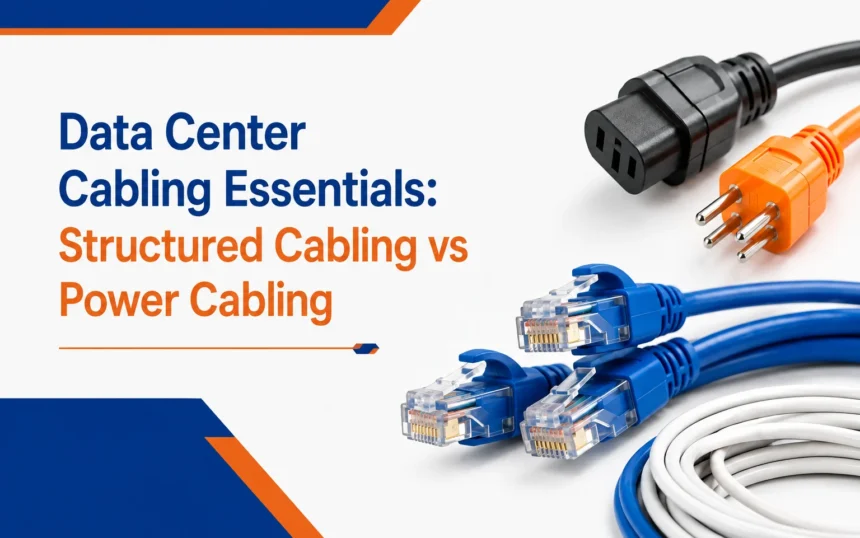
Every data center runs on two cabling systems working side by side. One carries electricity. The other carries information. Mix them up during planning, and you end up with overheating racks, signal interference, or a maintenance nightmare when something finally needs to be traced and replaced.
At Bharat Trading Corporation (BTC), we work with data center operators, telecom network providers, IT infrastructure developers, and system integrators who need both sides of this equation sorted out reliable power cabling that keeps servers running, and structured cabling that keeps data moving cleanly between them. Here’s how the two differ, why the distinction matters, and what to look for when sourcing cables and accessories for a data center build or upgrade.
Structured Cabling vs Power Cabling: What’s the Real Difference?
- Power cabling:
is exactly what it sounds like the wiring that delivers electricity from the incoming supply, through backup systems like UPS units and generators, and out to servers, cooling equipment, and networking hardware. This includes armoured and unarmoured power cables, along with the switchgear and distribution equipment that manages load safely across a facility.
- Structured cabling:
on the other hand, is the organized system of cables, control wiring, and management hardware that carries signal and data connecting servers, switches, routers, and monitoring systems in a predictable, documented layout. It also covers the physical side of that job: the ducts, trays, ties, and sleeves that keep hundreds of cable runs from turning into a tangled mess.
on the other hand, is the organized system of cables, control wiring, and management hardware that carries signal and data connecting servers, switches, routers, and monitoring systems in a predictable, documented layout. It also covers the physical side of that job: the ducts, trays, ties, and sleeves that keep hundreds of cable runs from turning into a tangled mess.
Why Power Cabling Needs Special Attention in a Data Center
Data centers run 24×7, which means power cabling has almost no room for failure. A few things matter more here than in a typical commercial or industrial setup:
- Continuous load handling. Cables need to carry sustained current without overheating, since racks run around the clock at high density.
- Backup integration Power has to move cleanly from the grid into UPS systems and generators and back out again, with cabling and terminations rated for that switching.
- Fire safety in enclosed spaces Server rooms are tightly packed with expensive, sensitive equipment, so cable insulation matters as much as conductivity.
Bharat Trading Corporation supplies armoured and unarmoured power cables from our Wires and Cables range, including RR Kabel and Dynamic Cable options, for stable power distribution across data and communication facilities. For environments where fire risk is a real concern server rooms, telecom shelters, enclosed equipment rooms fire-resistant (FR), flame-retardant low smoke (FRLS), and low smoke zero halogen (LSZH) cable options help limit flame spread and reduce smoke emission if something does go wrong.
Why Structured Cabling Needs a Different Set of Priorities
Structured cabling isn’t about carrying current it’s about carrying signal cleanly and keeping a facility maintainable as it scales. Two priorities dominate here:
- ● Signal integrity. Electrical noise and electromagnetic interference (EMI) near power runs can degrade data accuracy, so shielded control and instrumentation cabling is used to keep signal transmission stable.
- ● Organized routing. Dense server environments have hundreds of cable runs feeding switches, sensors, and monitoring systems. Without proper cable management, airflow suffers, troubleshooting takes longer, and every future addition becomes harder than it should be.
This is where cable ducts, cable ties, and sleeving come in not as an afterthought, but as core infrastructure. BTC’s Cable Ducts range from Trinity Touch and Shree Gopal Industries, including PVC wiring ducts and DIN rail accessories, is built for exactly this kind of organized, serviceable routing inside panels and along cable trays. For bundling and securing runs, our Cable Tie range from KSS and Elettro keeps structured cabling neat without adding bulk.
Terminations: The Part That Gets Overlooked
A cable is only as reliable as its termination. Loose or corroded connections are one of the most common causes of downtime in electrical systems, and data centers where a bad connection can mean a failed server or a dropped network segment can’t afford that risk.
BTC’s Lugs & Gland range from Jainson covers cable terminal ends and cable glands designed for secure, moisture-resistant termination on both power and control cabling. Pair that with heat-shrink sleeves and insulation accessories from Woer, PTFE, Shree Gopal Industries, and Siddhi Vinayak Bus Bar, and every joint and termination gets the protection it needs to hold up over years of continuous operation.
Power Distribution and Control: Where Both Systems Meet
Behind the scenes, power cabling and structured cabling connect through distribution and control hardware. BTC’s Switchgear range from Schneider Electric covers circuit breakers, protection relays, and power monitoring equipment that manage how electricity moves safely from the supply into the rest of the facility.
On the control side, our Terminal Blocks range from Connectwell and Suraj Electronics including DIN rail terminal blocks and switch-mode power supply (SMPS) units for DC output supports the low-voltage control and monitoring wiring that keeps cooling systems, sensors, and safety equipment coordinated with the rest of the electrical setup. Panel accessories round this out, keeping control panels organized and every connection accessible for maintenance.
Practical Tips for Planning Data Center Cabling
A few things worth keeping in mind whether you’re building a new facility or upgrading an existing one:
- Separate power and data runs wherever possible Running power and signal cables too close together invites interference proper routing and cable management (ducts, trays, ties) helps keep the two apart.
- Don't treat fire-safe cabling as optional In an enclosed server room, standard PVC cabling can produce heavy smoke in a fire event. FR/FRLS/LSZH options are worth the difference for critical spaces.
- Plan terminations as carefully as the cable run itself A high-quality cable with a poor termination is still a weak point in the system.
- Think in terms of maintainability, not just installation day Structured cable management that looks tidy on day one but can't be added to later will cost more in labour down the line than it saved upfront.
- Match the cable to the load, not just the space Power cables need to be sized for actual continuous load, especially with high-density racks and backup integration in the mix.
Sourcing Data Center Cables from a Single Supplier
Coordinating structured cabling and power cabling from multiple vendors adds friction different lead times, inconsistent documentation, and more points of failure when something needs replacing. Bharat Trading Corporation works as a single wires and cables supplier for data centers, telecom infrastructure, IT parks, and command centers, covering power cables, control and instrumentation cables, cable management systems, terminations, and the switchgear and terminal blocks that tie it all together. You can see the full picture of how we support this sector on our Data & Communication Industry page.
Frequently Asked Questions
Q1: Is structured cabling the same as networking cable?
Structured cabling is the broader system it includes the physical cable management (ducts, trays, ties) alongside the control and instrumentation wiring, not just the network cable itself.
Q2: Can the same cable ducts be used for both power and data cabling?
It’s better practice to route power and data separately, even within the same duct system, to reduce interference. Bharat Trading Corporation’s cable duct range supports segmented, organized routing for exactly this reason.
Q3: Why do data centers need fire-resistant cables specifically?
Server rooms hold sensitive, high-value equipment in enclosed spaces. FR/FRLS/LSZH cables limit flame spread and reduce smoke and toxic gas emission, which protects both equipment and evacuation routes in the event of a fire.
Q4: What should I look for in a cable termination for a data center?
Moisture resistance, a tight mechanical connection, and proper insulation. BTC’s lugs, glands, and heat-shrink sleeves are built to keep terminations secure over long-term, continuous operation.