
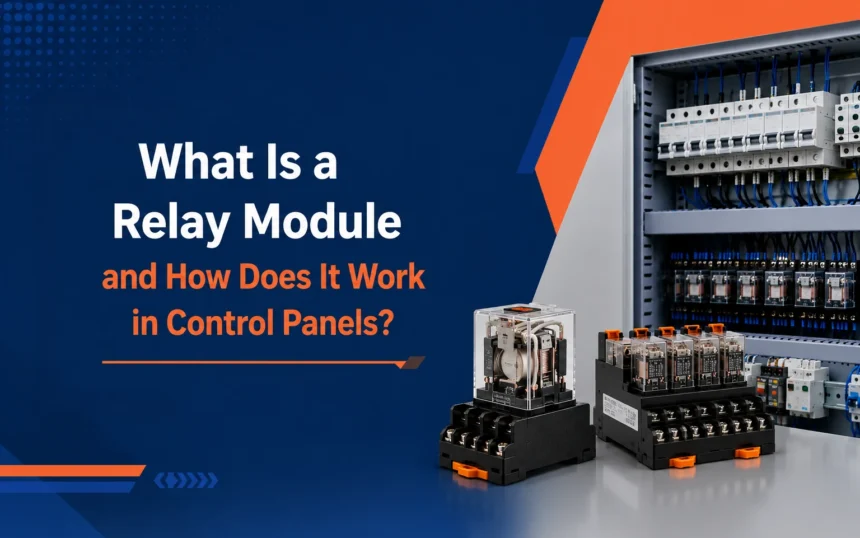
What Is a Relay Module and How Does It Work in Control Panels?
If you’ve ever opened up an industrial control panel, chances are you’ve seen a row of small, DIN-rail-mounted blocks sitting quietly between the PLC wiring and the field devices. These are relay modules, and while they rarely get the spotlight, they are one of the most important building blocks of a safe, reliable control panel.
At Bharat Trading Corporation (BTC), we supply relay modules and relay interface boards from Connectwell to panel builders, OEMs, and system integrators across India. In this post, we’ll walk through what a relay module actually is, how it works, the different types available, and how to choose the right one for your application.
What Is a Relay Module?
A relay module is a compact, panel-mountable device that houses one or more relays along with the terminals, sockets, and indicators needed to wire it into a control panel quickly and safely. Instead of hard-wiring a bare relay and building your own base, mounting, and labelling arrangement, a relay module gives you a ready-to-install unit that snaps onto a standard DIN rail.
In simple terms, a relay module lets a low-power control signal from a PLC, a sensor, or an automation controller safely switch a much larger load, such as a motor starter, contactor coil, solenoid valve, or indicator lamp, without the low-voltage control circuit ever coming into direct contact with the higher-voltage load circuit.
How Does a Relay Module Work?
At its core, every relay module works on the same basic principle:
- Input signal - A control signal (typically from a PLC output, sensor, or controller) energizes the relay's coil.
- Switching action - The energized coil either mechanically pulls a set of contacts together (in an electromechanical relay) or triggers a semiconductor switch (in a solid-state relay), completing the output circuit.
- Output switching - The now-closed output contacts switch the connected load a motor contactor, valve, lamp, or another circuit on or off.
- Isolation - Because the input (control) side and output (load) side are electrically separated, the relay module protects sensitive PLC and automation electronics from voltage spikes, electrical noise, and load-side faults.
Most relay modules also include an LED indicator that lights up when the coil is energized, so panel technicians can see the module’s status at a glance during commissioning and troubleshooting a small feature that saves a lot of time on the panel floor.
Types of Relay Modules Bharat Trading Corporation Supplies
Bharat Trading Corporation stocks a range of Connectwell relay modules and relay interface boards to suit different panel-building needs:
- Modular Relays (CRM and CRL Series)
These are DIN-rail relay-with-base assemblies, available as:
- ● CRM Series Modular Power Relays – available with 1, 2, or 4 changeover contacts, in coil voltages ranging from 12V DC up to 220V DC/AC, with contact current ratings from around 5A to 12A. Several variants include an LED status indicator and a manual override (test button), which lets technicians force the contact without energizing the coil handy during panel testing.
- ● CRL Series Miniature Relays – a more compact changeover relay option for applications where panel space is limited.
- CIMRE Next Generation Relay Interface Boards
CIMRE relay modules are a fully enclosed, IP20-rated relay interface solution built for modern control panels. They’re available in both pluggable and soldered versions, with 1 or 2 change-over contacts and multi-channel configurations (2CH, 4CH, and 8CH boards), in 24V DC and 230V AC coil voltages. The enclosed IP20 design adds a layer of protection against accidental contact, which matters in busy panel enclosures.
- Slim Relay Modules - Electromechanical
Our slim relay module range is built for panels where DIN-rail space is at a premium. These electromechanical relay modules are available with screw clamp or spring clamp terminal connections, across a wide voltage range 5V, 12V, 24V, 48-60V, 120V, and 230V so you can match the module to your PLC or controller’s output voltage without adapters.
- Slim Relay Modules - Solid State (SSR)
For applications involving frequent switching or where contact wear and switching noise need to be minimized, BTC also supplies slim solid-state relay modules, which switch electronically rather than mechanically.
- CW Modular Relay Sockets
For panels using standalone plug-in relays, Bharat Trading Corporation also stocks Connectwell relay sockets separately, including 1 CO (SPDT) general purpose sockets, 2 CO (DPDT) general purpose and industrial sockets, and 4 CO (4PDT) industrial relay sockets useful when you’re specifying relays and bases independently rather than as a pre-assembled module.
Key Features to Look for in a Relay Module
When specifying relay modules for a control panel, a few features are worth paying attention to:
A few practical points to keep in mind when sizing a lug:
- Changeover configuration (1CO / 2CO / 4CO) - how many independent contact sets you need per module
- Coil voltage - must match your PLC output or control voltage (5V, 12V, 24V, 110V, 230V, etc.)
- Contact current rating - how much load current the output contacts can safely switch
- Terminal type - screw clamp or spring clamp, depending on your panel wiring standard and how often terminals are reworked
- Pluggable vs. soldered - pluggable modules are easier to service and replace in the field; soldered versions offer a more permanent, vibration-resistant connection
- LED indication and manual test/override - speeds up commissioning and fault-finding
- Enclosure rating (e.g., IP20) - added protection in enclosures with limited clearance
Why Relay Modules Matter in Control Panels
Relay modules do more than just “switch things on and off.” In a well-designed control panel, they:
BTC’s Jainson Cable Glands range includes:
- Isolate PLC and automation electronics from the higher-voltage, higher-current field devices they control, protecting sensitive controllers from load-side faults and transients
- Allow low-power outputs to control high-power loads such as motor contactors, solenoids, and heaters, without oversizing the controller's own output stage
- Simplify wiring and maintenance since a faulty pluggable relay module can be swapped out in seconds without disturbing surrounding terminal wiring
- Improve panel safety and organization especially when mounted alongside terminal blocks on the same DIN rail
This is why relay modules are found in nearly every control panel BTC’s customers build from switchgear panels and automation cabinets to panels used in power transmission & distribution, construction & building, and OEM machine-building applications.
Choosing the Right Relay Module Supplier
Because relay modules sit at a critical point in a control panel between the controller and the load, sourcing them from a reliable relay module supplier matters as much as the specification itself. A few things to consider when choosing a relay module dealer:
- ● Does the supplier stock a genuine, traceable brand (like Connectwell) rather than unbranded substitutes?
- ● Can they supply the full range you need modular relays, slim relay modules, relay interface boards, and sockets from a single source, so your BOM doesn’t get split across multiple vendors?
- ● Can they support both small trial orders and bulk panel-building requirements?
- ● Do they understand panel-building applications well enough to help you match voltage, contact rating, and terminal type correctly the first time?
Why Choose BTC as Your Relay Module Supplier and Dealer
Bharat Trading Corporation has been supplying wires, cables, switchgear, terminal blocks, and panel accessories to India’s power, infrastructure, automation, and industrial sectors since 1987. As an authorized dealer and distributor for Connectwell, we supply the full relay module range covered above modular power relays, miniature relays, CIMRE relay interface boards, slim electromechanical and solid-state relay modules, and relay sockets alongside complementary panel-building products like terminal blocks and panel accessories, so panel builders can source what they need without juggling multiple suppliers.
If you’re specifying relay modules for a new panel build or need to source a like-for-like replacement for an existing one, our team can help you match the right series, voltage, and contact configuration to your application.
Frequently Asked Questions
Q1: What is the difference between a relay module and a standalone relay?
A standalone relay is just the switching element itself. A relay module packages the relay (or relays) together with a base, terminals, and often an LED indicator into a single DIN-rail-mountable unit, making panel wiring faster and more organized.
Q2: What is a relay interface board used for?
A relay interface board, like BTC’s CIMRE range, is a multi-channel relay module that lets a PLC or controller switch several outputs from one compact, enclosed unit useful where panel space is tight and multiple relay points are needed close together.
Q3: What's the advantage of a slim relay module over a standard relay module?
Slim relay modules are designed with a narrower DIN-rail footprint, so panel builders can fit more switching points into the same enclosure width helpful in compact control panels and machine-mounted enclosures.
Q4: Should I choose a pluggable or soldered relay module?
Pluggable modules are easier to service, since a faulty relay can be replaced without re-wiring the terminals. Soldered versions offer a more permanent connection and are often preferred in applications with higher vibration.
Q5: Does Bharat Trading Corporation supply relay modules for bulk panel-building orders?
Yes. As a relay module supplier and dealer for Connectwell, BTC supports both smaller trial quantities and bulk requirements for panel builders, OEMs, and system integrators.